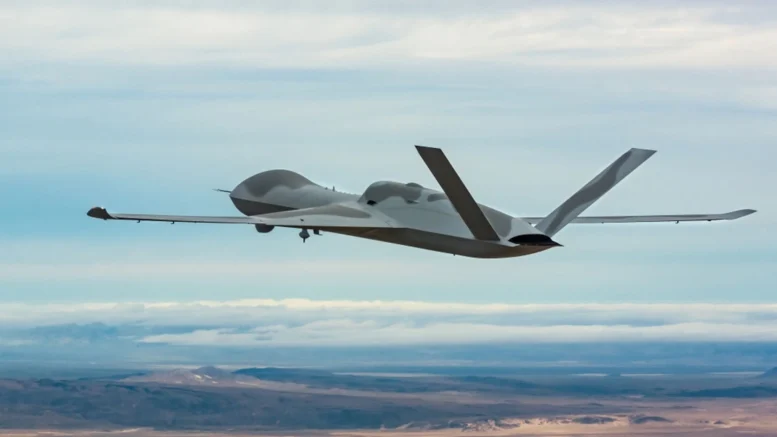
Aviation News – General Atomics Aeronautical Systems, Inc. (GA-ASI) and the U.S. Air Force successfully conducted a live autonomous mission at Edwards Air Force Base, pairing an F-22 Raptor with an MQ-20 Avenger unmanned jet. This demonstration proves that human-piloted fighters can effectively command robotic wingmen in complex combat scenarios, a vital step for future aerial warfare.
The test, conducted in Southern California, utilized the latest government reference autonomy software to bridge the gap between crewed and uncrewed platforms. During the mission, a pilot aboard the F-22 acted as the command authority, sending high-level directives to the MQ-20 through the Autonodyne Bashi Pilot Vehicle Interface (PVI). This collaboration relied on a tactical data link to ensure seamless communication, allowing the unmanned jet to execute real-time tactical adjustments based on the pilot’s mission requirements.
The technical success of the flight centered on the MQ-20’s ability to receive and execute teaming commands autonomously while performing Combat Air Patrol (CAP) and airborne threat engagement tasks. By offloading these maneuvers to the unmanned jet, the system demonstrates a significant operational impact, potentially increasing the survivability of human pilots while expanding the battlefield footprint of a single squadron. This rapid software integration confirms that autonomous systems can adapt to the shifting waypoints and aggressive maneuvers required in modern dogfights.
“This demonstration showcased Manned-Unmanned Teaming and rapid software integration between the MQ-20 and the F-22, highlighting the ability to receive and execute teaming commands,” noted a representative involved in the mission’s coordination.
This milestone paves the way for the U.S. Air Force to integrate more sophisticated Collaborative Combat Aircraft (CCA) into its active inventory. As the military continues to refine these AI-driven capabilities, the focus will shift toward scaling these operations for large-scale conflict environments.
The successful flight at Edwards Air Force Base validates the maturity of autonomous mission software in high-performance aircraft. By proving that the F-22 can lead a “loyal wingman,” the defense industry moves closer to a future where human intelligence and machine precision work in perfect lockstep.